
When the Lights Went Out in Spain — And Why California Should Pay Attention


Dr. Gene Nelson posed a specific and consequential question: if Diablo Canyon is shut down and the California power grid becomes primarily dependent on Inverter Based Resources (IBRs), could the pumps at Edmonston Pumping Plant collapse regional voltage — and possibly damage the pump motors? The short answer is yes, although protection systems would likely trip the pumps before physical damage occurred. The reason why is a longer conversation, and it has direct implications for every energy policy decision California is currently making.
The Edmonston Pumping Plant
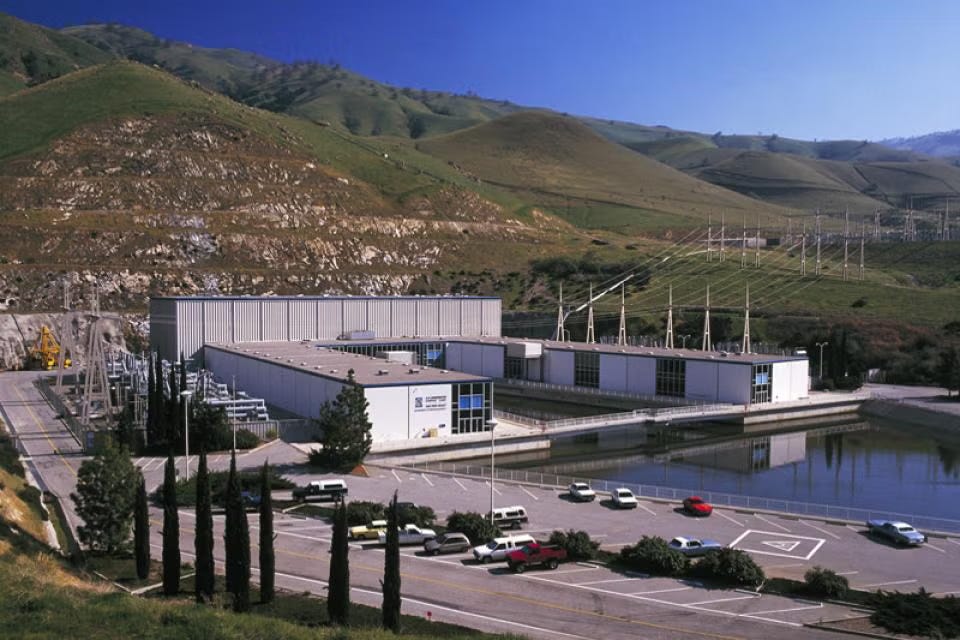
The A.D. Edmonston Pumping Plant lifts water from California’s Central Valley over the Tehachapi Mountains to the Los Angeles basin — a vertical rise of 1,926 feet (about twice the height of the Empire State Building), the highest single-lift pumping operation in the world outside of pumped storage. The plant was built with fourteen 80,000 horsepower (60 MW) synchronous motors. Four of the original Westinghouse units have since been replaced with Hitachi equipment; the reactive power characteristics of those replacement units are pending verification and warrant confirmation from DWR and CAISO as part of any formal reliability assessment of this corridor. The remaining original units are synchronous motors capable of generating reactive power to actively support system voltage.
The station is served by a dedicated 230 kV transmission line from Pastoria Substation in Southern California Edison territory. Pastoria sits on Path 26, directly adjacent to the junction with Path 15 — the primary transmission corridors connecting California to Arizona in the south and to Northern California in the north. This geographic position is critical to the regional reliability argument developed below.
Starting those massive motors without collapsing the transmission system requires a specialized solution. Two Motor-Generator (MG) sets accomplish this by starting each pump motor on an isolated bus, ramping voltage from near-zero through controlled field excitation of the MG generator, and synchronizing the motor to the grid only after it reaches synchronous speed. The grid never sees the locked-rotor inrush. Without this system, starting a single 60 MW synchronous motor could demand up to ten times its running load — nearly the entire capacity of the Pastoria 230 kV feed consumed by a single pump start, almost entirely as reactive current. Regardless of the starting method, the EPP represents a massive synchronous load on the regional power system at all times during operation.
Voltage and Inertia: The Twin Pillars
Much is written about inertia, and inertia is extremely important. But voltage builds the magnetic bonds that hold the power system together. Inertia keeps frequency from dropping out the bottom, or shooting over the top, every time there is a shift in system load. Voltage holds the power system together so that inertia can deliver that stabilizing energy. Without either, the power system tears itself apart.
What happens when a power system loses its ability to control voltage? Unfortunately, we now have a recent and well-documented example, and the parallels to California’s current direction are uncomfortably close.
The Iberian Blackout: A Case Study in Voltage Control Failure
On April 28, 2025, the electric power system on the Iberian Peninsula collapsed, creating the largest blackout in European history in more than two decades. Two earlier analyses — The Iberian Blackout — On That Day and The Iberian Blackout — The Reports — documented the operational sequence before any official reports were released, and those analyses held up. The official ENTSO-E report, published eleven months after the event, was politically filtered to avoid direct assignment of blame. Its headline conclusion — “the problem is not renewable energy, but voltage control, regardless of the type of generation” — is technically accurate in the narrowest sense and operationally misleading in context. The voltage control capability that was missing was precisely the reactive power support that synchronous machines provide inherently, as a byproduct of their physics.
Spain had followed the popular push toward an IBR-based power system without the engineering discipline that responsible high-IBR integration requires. The contrast with Ireland is instructive. EirGrid and SONI — operators of one of the highest IBR penetration systems in the world — recognized early that non-synchronous penetration above 50% required extraordinary engineering investment to manage safely. They built a formal multi-year program called DS3, raising their System Non-Synchronous Penetration (SNSP) limit from 50% to 75% through five incremental operational trials. Demonstrated engineering capability was required before each step was permitted.
Critically, Ireland backed that policy with hardware. EirGrid procured six synchronous condenser projects delivering nearly 7,000 MVA.s of low-carbon rotating inertia — including the world’s largest flywheel at Moneypoint, which alone provides 3,500 MWs of inertia. A hard system inertia floor of 23,000 MWs is enforced at all times. That is the engineering price of high IBR penetration done responsibly: rotating copper and iron, procured deliberately and sized to the task.
Spain reached similar IBR penetration levels with none of those investments in place. There were no synchronous condensers on the Spanish mainland, no grid-scale battery storage, and IBRs were allowed to operate in power factor control mode rather than voltage control mode, removing what little reactive support they could have provided. A political tax on nuclear generation had incentivized nuclear plants — the primary source of rotating reactive energy — to stay offline on the day of the collapse. Spain built a perfect trap. On April 28 it closed, and the grid fell in under two minutes.
The critical takeaway is not that Spain specifically ran out of the ability to reduce voltage. It is that Spain lost the ability to control voltage at all. It does not matter whether control is lost to the high side or the low side. Loss of voltage control means system collapse. Notably, a Bloomberg investigation published in August 2025 found that Spain invested only $0.30 in grid infrastructure for every dollar spent on renewables — against an EU average of $0.70. The UN Secretary General stated the ratio should be one to one. California’s grid infrastructure investment trajectory mirrors Spain’s, not Ireland’s or the UK’s.
Sidebar: A Distribution-Level Parallel
The same phenomenon occurs at a smaller scale on very hot days. When a feeder carrying heavy air conditioning load trips and recloses, all compressors attempt to restart simultaneously, collapsing voltage until they stall in locked rotor. Rooftop solar behind the meter has compounded this problem by forcing distribution capacitors offline for voltage control — when the feeder trips, solar inverters shut down but the capacitors cannot recover in time. Modern HVAC systems largely address this with time-delayed compressor restarts. The underlying principle is identical to the bulk system problem: reactive demand recovery after a voltage disturbance can exceed the system’s available reactive supply, and the voltage cannot recover.
The California Parallel
The parallels between pre-blackout Spain and California’s current trajectory are not subtle. California’s SB 100 mandates 100% zero-carbon electricity by 2045. The CPUC’s Integrated Resource Plan proceedings have systematically favored IBR resources over dispatchable synchronous generation. The original decision to close Diablo Canyon — reversed only after the 2020 rolling blackouts made the reliability gap impossible to ignore publicly — was made on political grounds, not on the basis of engineering analysis.
Southern California’s structural synchronous grid inertia (SGI) deficit began with the shutdown of San Onofre Nuclear Generating Station (SONGS) in January 2012. SONGS provided substantial localized reactive support and synchronous inertia to the southern California coastal transmission system. Nearly all generation capacity added to serve southern California since 2010 has been inverter-based, contributing negligible synchronous grid inertia. The claim that distant synchronous generation compensates for this deficit is contradicted by the physics of AC transmission — reactive power loses effectiveness with distance and impedance, and the constraints on high-voltage AC transmission lines from the Pacific Northwest mean that remote generation cannot substitute for the localized reactive support SONGS once provided. The closure of Diablo Canyon would deepen this deficit further.
California is removing rotating inertia and traditional reactive resources from its power system, replacing them with IBRs and batteries on the unproven assumption that they are a fully functional replacement for rotating resources. Like Spain, California has avoided adding the flywheel-equipped synchronous condensers that European grid operators recognize as essential in high-IBR systems — investments that would cost California ratepayers billions of dollars for equipment that produces no electricity. IBRs, even when voltage support is fully enabled, provide extremely limited reactive capability and can never perform beyond their rated current. There is no thermal reserve in a power electronic device. Rotating copper and iron, by contrast, can sustain operation well beyond nameplate ratings for short periods, responding to system disturbances naturally and without programming — delivering both inertia to stabilize frequency and reactive energy to control voltage. Physics does not respond to legislative mandates.
Diablo Canyon, Edmonston, and the Path 26 Corridor
The maps below, sourced from the WECC 2024 Path Rating Catalog, show the transmission geography that defines this argument. Path 15 runs along the California coast, with Diablo Canyon at its southern anchor. Path 26 runs from Midway substation southward to Vincent, passing through the Pastoria area where Edmonston’s 230 kV feed originates. Midway substation is the geographic junction between the two paths — the point where Diablo Canyon’s reactive support and Edmonston’s reactive demand share the same regional transmission picture.
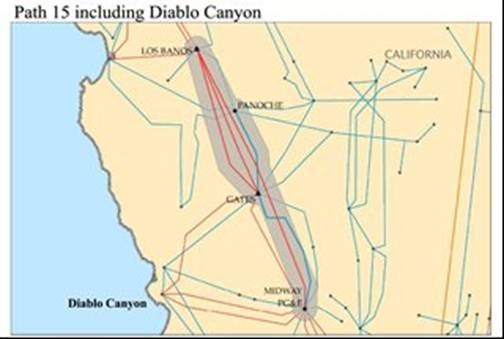
Path 15 including Diablo Canyon. Source: WECC 2024 Path Rating Catalog
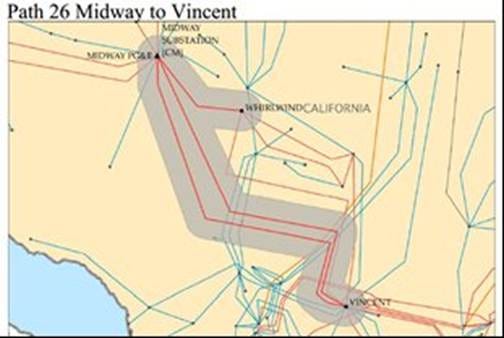
Path 26, Midway to Vincent. Pastoria Substation — the dedicated 230 kV feed for Edmonston Pumping Plant — sits along this corridor. Source: WECC 2024 Path Rating Catalog
Diablo Canyon sits on California’s central coastal 500 kV transmission system. Path 26 runs from the Tehachapi area southward toward the Los Angeles basin. Edmonston’s dedicated 230 kV feed originates at Pastoria Substation on Path 26. These facilities share the same regional transmission picture. The reactive support that Diablo Canyon provides to the coastal transmission system is in the same corridor as the reactive demand that Edmonston represents on Path 26. Removing Diablo Canyon’s synchronous generation does not simply retire 2,200 MW of carbon-free electricity — it removes dynamic reactive support from a corridor that already carries a large synchronous motor load whose reactive behavior during a voltage disturbance is significant and fast.
Diablo Canyon is already paid for. It is well maintained and designed to operate for a century. It currently provides more synchronous grid inertia than any other generation facility in California. The alternative — replacing its SGI contribution with flywheel-equipped synchronous condensers — would cost ratepayers billions of dollars for equipment that produces no electricity. The Siemens Energy Rotating Grid Stabilizer whitepaper documents what this hardware costs and how long it takes: even a brownfield conversion of a retired power plant generator takes six months from engineering study to commissioning and runs up to 50% of greenfield cost. Ireland’s experience at Moneypoint and the UK’s Stability Pathfinder program document the scale of investment required across an entire grid. California would be paying billions to partially replicate a service currently provided for free as a byproduct of an already-operating, already-paid-for nuclear plant.
The Fault Scenario: Theory Grounded in Documented Precedent
The most credible failure scenario for the Edmonston corridor involves a three-phase transmission fault with a breaker failure on Path 26. This is not a hypothetical. It has documented precedent in the same regional grid involving another nuclear plant.
On June 14, 2004, at 07:40:55 in the morning, a single phase-to-ground fault occurred on the Western Area Power Authority’s 230 kV Liberty–Westwing line near Phoenix, Arizona. The initiating cause was a heron taking flight from the line. What should have been a routine fault clearance became a regional cascade because two contacts in a single Westinghouse AR auxiliary relay — manufactured in 1974 — failed to close. Breaker WW1022 did not trip. Because both the trip signal and the breaker failure initiation signal shared the same failed contacts, the breaker failure scheme also did not fire. The fault could not be cleared locally within the 230 kV yard. It propagated to the 525 kV system through the Westwing transformers, and the remote ends of every line feeding Westwing began tripping to isolate what the protection could not contain locally. All three Palo Verde nuclear units tripped. Redhawk generating units tripped. Approximately 55,000 customers across Arizona Public Service and Tucson Electric Power lost power. The entire cascade originated from two relay contacts that failed to close in a 30-year-old electromechanical relay.
That is the initiating event topology for the Edmonston scenario. A single protection failure on a 230 kV line in the Path 26 corridor, breaker failure signal lost, fault propagates to the 525 kV system. What follows next depends entirely on what reactive resources are available to recover voltage as the system fights to contain the disturbance.
In 2004, Palo Verde was online. Its synchronous generators responded. The system recovered. In the IBR-dependent system California is building, that reactive recovery response does not exist in the same form.
Whether the EPP synchronous motors — including the Hitachi replacement units — are equipped with Automatic Voltage Regulators (AVRs) is a detail that warrants immediate verification by CAISO and DWR as part of any formal reliability assessment of this corridor. An AVR-equipped synchronous motor can act, within limits, as a synchronous condenser — actively supporting voltage recovery after a fault clears. Without AVRs, that capability is absent and the motors become a pure reactive burden on a system already struggling to recover.
Once the fault clears, the power system requires an immediate injection of MVARs to recover voltage and arrest the advancing power angles. The synchronous generators at Diablo Canyon would respond naturally — increasing excitation and injecting reactive energy into exactly the corridor that needs it. In a system without that synchronous generation, that reactive response does not exist. BESS systems can only deliver rated current, split across competing demands for voltage support, frequency response, and energy delivery simultaneously. As the EPP pumps continue to torque toward loss of synchronism, reactive demand increases further. A fixed field current delivers no additional reactive energy to pull power angles back. As voltage falls at the distribution level, motor loads demand more reactive power to avoid locked rotor. IBRs begin tripping on self-protection protocols, accelerating the collapse. There is a moment at which the system either recovers or it does not.
Conclusion
The glue that holds a power system together during a major transmission event is available reactive energy for voltage control. IBRs do not have it in sufficient quantity, and that deficit cannot be engineered around with current technology at the scale California requires. On a system without adequate synchronous generation, the Edmonston Pumping Plant can pull the regional grid apart.
The CPUC should require CAISO to measure synchronous grid inertia in real time rather than rely on models. Technology to do this exists today. GridMetrix, developed by Reactive Technologies, provides direct real-time measurement of grid inertia using a power pulse technique validated on grids worldwide. Currently, grid inertia is modeled, not measured — causing operators to make consequential decisions based on estimates rather than data. The structural SGI deficit in southern California that this paper describes is measurable. California is making irreversible infrastructure decisions affecting 40 million people and one of the world’s largest economies without knowing the real-time state of its own grid’s stability margin. The CPUC has the authority to require CAISO to deploy real-time SGI measurement and to demonstrate that any proposed generation retirement or IBR addition maintains adequate system strength. That requirement should be in place before any further synchronous generation is retired.
There is a place for all types of energy on the power system. But the composition of that mix must be determined by engineering physics, not political mandate. The Iberian Peninsula demonstrated what happens when that boundary is crossed. Ireland demonstrated what responsible high-IBR integration actually costs in hardware and engineering discipline. Diablo Canyon is already paid for, already operating, and already providing the synchronous grid inertia that California cannot afford to lose. The CPUC has the authority — and the obligation to ratepayers and to public safety — to ensure that California’s energy transition is governed by engineering analysis, not by legislation alone.
 | A guest post by
|