

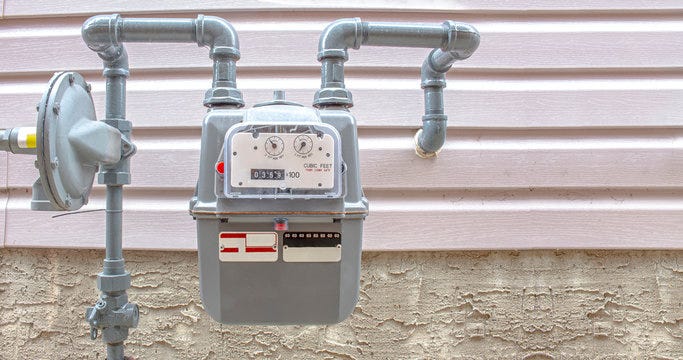
Electric Distribution Utilities rarely catch a break in the news, in blogs, or in politics. They get called out on a continuous basis, but when was the last time your Gas Distribution Utility made a splash? Unless you are one who closely watches the proceedings of your State Public Utilities Commission, you might be struggling to remember who your gas utility is, and that’s not an accident.
The Ohio Case
Today I got an email from the President of Columbia Gas of Ohio, Bob Heidorn. I have received a few from Bob this year, which is extremely rare, plus two customer surveys, weird. Bob wanted to tell me all about how half of my bill goes to service the pipelines and keep them in operating order — except that’s not close to right. Delivery and distribution charges run roughly 20 to 25 percent of a typical residential bill; the other 75 to 80 percent is the supply/commodity cost of the gas itself, which Columbia doesn’t profit from and passes through at cost. He talked about how hard this was in the winter (what’s your point, Bob?). With this latest letter I started to wonder if he is a new president and wants to improve customer relations, so I asked Claude. He is not, he has been in place since 2024, been with the company for years. So why now?
What came up was the now-completed court case for a rate increase. The case has been in the courts since 2023, the Ohio Supreme Court decided in favor of Columbia Gas on June 25, 2026. Since it went all the way to the Ohio Supreme Court, this case got an uncomfortable amount of press from a gas utility’s point of view, and all this customer engagement is simply damage control. Interesting, since I was clueless until Bob sent me an email.
The two customer surveys revolved around their app and their website. I’d call it spartan, just enough to do your business and get out. Oh, there is information if you are building something new and want to connect. But if you are an existing customer, pay your bill, here’s how much you’ve used by the month, zero features. I was pretty frank on both surveys that their website kind of sucks; you can get your bill paid, but if you want to see how your bill compares, or how much gas you used on Tuesday, you are out of luck.
This led to a technology investigation of the meter on my house, and sure enough, that meter is capable of supplying sub-hourly data. That means not providing the data is a choice, and one I am not OK with.
It’s Not Just Ohio
As preparation for this piece, we took a look at non-energy-related rate increase requests across the USA. Bingo, they are ringing up everywhere, and they have a theme. Replacement of aging infrastructure for safety, system improvements, and modernization. Here are just a few:
National Grid’s Massachusetts gas utility filed in January 2026 for roughly $342 million in additional gas distribution revenue — a request the state regulator suspended until December 2026 pending investigation. If approved, it would raise a typical heating customer’s bill by about $23.66 a month, 8.4%.
National Fuel Gas in New York received its first base delivery rate increase since 2017, raising bills by about $5.97 a month, with further phased increases through 2026.
Orange & Rockland’s gas heating customers in the Hudson Valley face a three-year rate plan with increases of 10.9%, 3.5%, and 3.8%.
Nicor Gas in Illinois has a $221 million rate request on the table, a 6.7% increase — even while marketing itself as one of the cheaper gas utilities around by comparison.
Atmos Energy in Colorado got approved for a 13.8% base rate increase, the largest in 25 years — and asked customers to cover $674,868 of its own outside legal fees for running the rate case.
PG&E — this one gets its own section below, because it deserves the space.
These are some of the bigger ones, but I am willing to bet if my readers look at their gas utilities, there is a rate case floating around out there.
What “Smart” Actually Means
There are two meter technologies out there, AMR, or Automatic Meter Reading, and AMI, or Advanced Metering Infrastructure. AMR is considered a “legacy” system at this point, although still widely deployed by water districts and many gas utilities.
AMR is a drive-by meter reader; the utility drives a radio-equipped truck, or a radio-equipped meter reader walking a route to pull the data, almost always monthly. It is strictly one-way communication, meter to the reader device, the only thing the meter looks for is a viable connection to the reader. REU has a strict policy against smart meters (that I disagree with), they used these AMR meters where the meter was in the backyard of “hostile” customers that blocked access and often deployed guard dogs.
AMI is a whole system, two-way communication, rich data collection beyond just meter reads. It can provide sub-hour use data, and flow (demand), beyond just a simple one and done meter read. This makes it an endpoint data node on the gas distribution system to tell the utility what is going on. In 2026, Columbia Gas has begun rolling out the Itron Intelis Gas Meter for most new construction.

This meter is the full equivalent of the electric utility smart meter, including tamper sensing and a remote-control integrated shutoff valve, all the toys. Pressure sensing comes standard on the higher-capacity 425-class version; on the smaller 250-class meter, the one more likely on a standard residential service, it’s an option the utility has to actually order (likely just a software switch). In urban and suburban areas with high meter counts, they are often supported by mesh networks with regularly placed transceivers. Meters are designed to be mesh connected to allow meters to become links in the mesh network repeaters for adjacent nodes.
Gas utilities initially installed AMR technology, so I took a look at what is installed on my home, a recent new build (2021). It has an Itron OpenWay Riva 500G ERT module installed on an old-style bellows-type gas meter, a bolt-on upgrade.
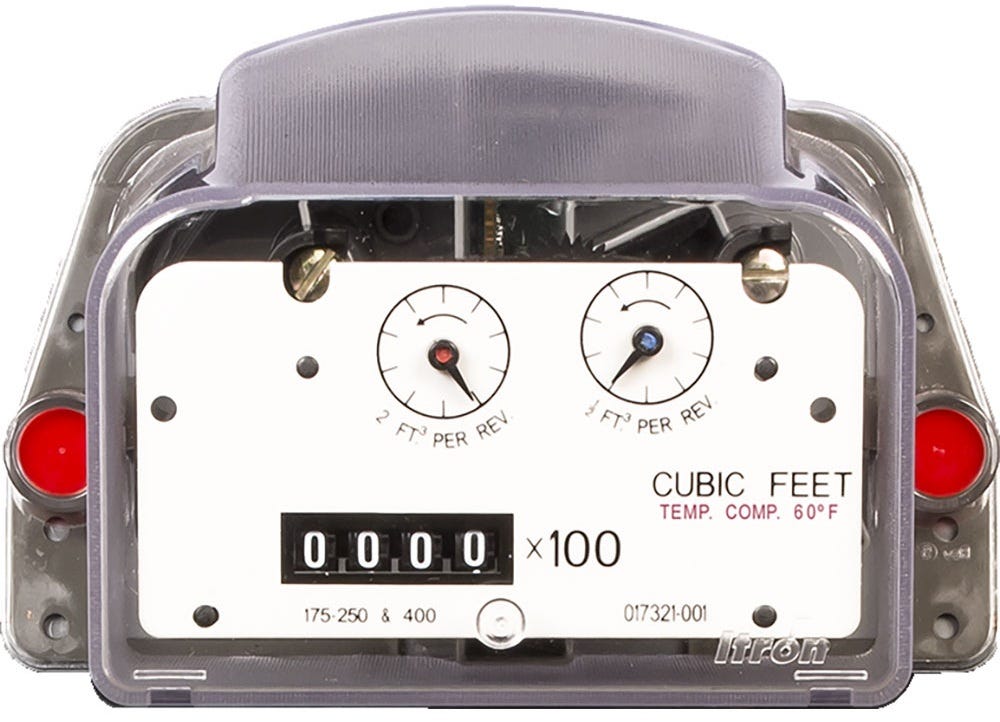
That 500G module is a fully functional AMI unit, it just lacks integrated controls and sensing in the meter itself. Otherwise, it’s fully functional as an AMI endpoint. However, all of the Itron smart meter technology is designed to be backwards compatible to the old AMR meter reading systems, that includes the Intelis Gas Meter. So, it’s quite possible Columbia Gas is buying the latest greatest endpoints, and connecting them to a Model T.
What is clear is these gas distribution utilities have the field equipment to collect a great deal of information, and you are paying for that equipment. What the gas distribution utilities are not doing is being transparent about how much data they are collecting. Furthermore, if they are collecting daily and hourly data, that meter data has value to you as a consumer, it technically belongs to you, and they are not sharing it.
PG&E’s Dead Batteries
Probably one of the strongest points of a utility essentially dumping their problems on the customer is PG&E of California. PG&E is a combination gas and electric utility; most press comes from the electric side. But it’s the same company, same management, same behavior. PG&E installed a large package of AMI gas meters back in its Smart Meter rollout, 2006 to 2012, they were battery-powered. Now those batteries are failing, and when they die, the meter defaults to a prerecorded reading. Customers have received estimated bills running into the thousands of dollars because of failing meter batteries — one reported case hit $6,000. In response, PG&E has filed a $498 million rate case to replace all those failing modules, the ones customers already paid for once, now pushing fifteen to twenty years old.
Nobody’s Counting
Electric utility smart meter deployment is carefully tracked by the EIA. Federal policy has pushed state regulators to at least consider requiring time-based metering, and stimulus funding drove a lot of the actual buildout, so most Investor-Owned Utilities ended up deploying it anyway. That’s on top of how closely electric utilities are watched and regulated generally, right up to FERC and NERC keeping the bulk power system reliable.
Gas utilities are an entirely different story; there is no government oversight on the gas industry’s smart meter deployment. So, there is no one looking out for you regarding how these meters are deployed and how that data gets distributed, a bit of a black hole. There may be some proactive state PUCs taking action, but it did not immediately come up in my research. It does fit the pattern of the gas industry as a whole. There is no “NERC”-like agency assuring uniform reliability compliance. Gas scheduling coordination with electric generation is still a pain point during high demand.
Closing
Like so much of the industry, this is a developing story. Articles like this will continue to shine a light on areas that need to be addressed. The gas industry is very much in transition, and despite the resistance, will eventually have to submit to deeper oversight. Please share your thoughts.
Around 2020 - 2022 (memory is weak) Austin TX tried to pass a city gas ban, starting with new construction and phasing up over time. Happily the Texas legislature headed them off with their own legislation.
In 2024, the gas provider, Texas Gas Service, claimed it was implementing a rate increase of about 10%, which was actually closer to a 50% increase. Most (all?) of the increase was in the "delivery charge".
The Austin City Council cried crocodile tears over the increase and promised "action", but I pretty much believe they told TGS to get the rate increase.
If you can't ban it, make it expensive.
I'm a paranoid old man.
I have been retired from Columbia Gas for 30 years. However, unless the PUCO has "changed its stripes", the monthly service charge on COH gas bills is approximately half of the actual fixed costs. Utility commissions set monthly service charges lower to make service more accessible for low income customers. Rates are set based on a "test year". If gas sales are lower than in the "test year", the utility underearns its allowable rate of return. If gas sales exceed "test year" sales, the utility overearns and might be required to refund the excess to customers. COH has "been there and done that" in the past.